How to Prepare CAD Files for Glass Bottle Manufacturing: A Complete Guide for Designers and Brand Ow
Article release time:8 2026 Pageview:166
How to Prepare CAD Files for Glass Bottle Manufacturing: A Complete Guide for Designers and Brand Owners
Designing a custom glass bottle begins long before the first mold is manufactured. Whether you are a packaging design agency, industrial designer, spirits brand owner, or beverage startup, providing a well-prepared CAD file is one of the most important steps toward a successful production process.
Many beautiful bottle concepts require significant engineering modifications before they can be manufactured. Understanding how glass bottle manufacturers interpret CAD files helps reduce development time, lower tooling costs, and avoid unnecessary revisions.
This guide explains how to prepare production-ready CAD files that manufacturers can efficiently convert into molds and mass-produced glass bottles.
Why CAD Files Matter in Glass Bottle Manufacturing
A CAD model is more than a visual representation of a bottle.
It serves as the engineering foundation for:
Mold development
Weight calculation
Glass distribution analysis
Structural strength evaluation
Neck finish compatibility
Decoration planning
Production feasibility
A complete CAD model allows manufacturers to evaluate manufacturability before investing in tooling.
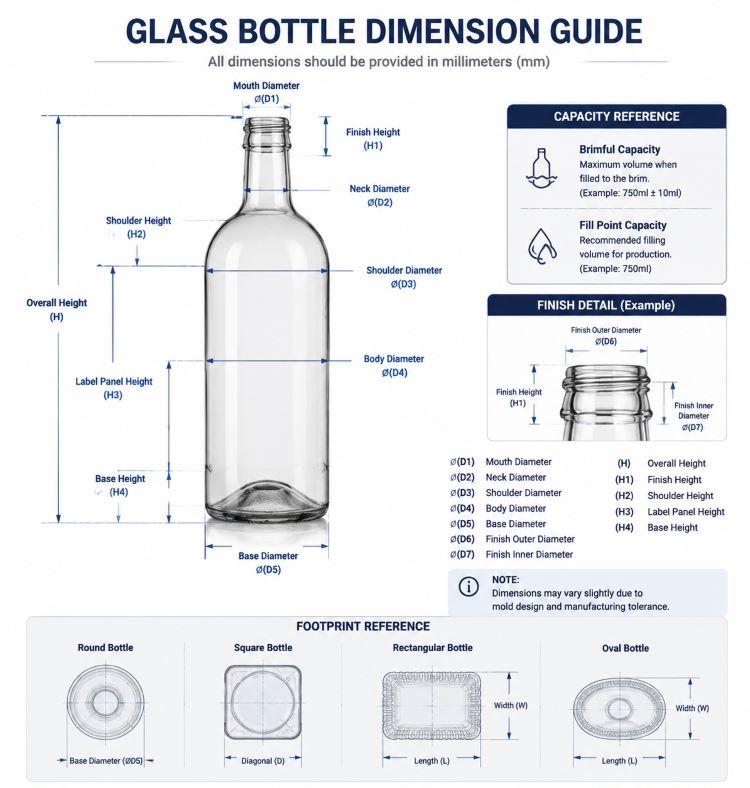
Bottle Capacity
Specify both:
Brimful Capacity
Fill Point Capacity
This information is essential for beverage filling lines.
Base Design
Heavy-base bottles require careful engineering.
Designers should define:
Base thickness
Push-up depth
Weight distribution
Center of gravity
Proper base design improves both appearance and production stability.
Neck Finish
The neck finish must match the intended closure.
Examples include:
Bar Top
Cork Finish
Screw Cap
GPI Finish
ROPP Finish
An incorrect neck finish can make the bottle unusable.
From CAD File to Glass Bottle
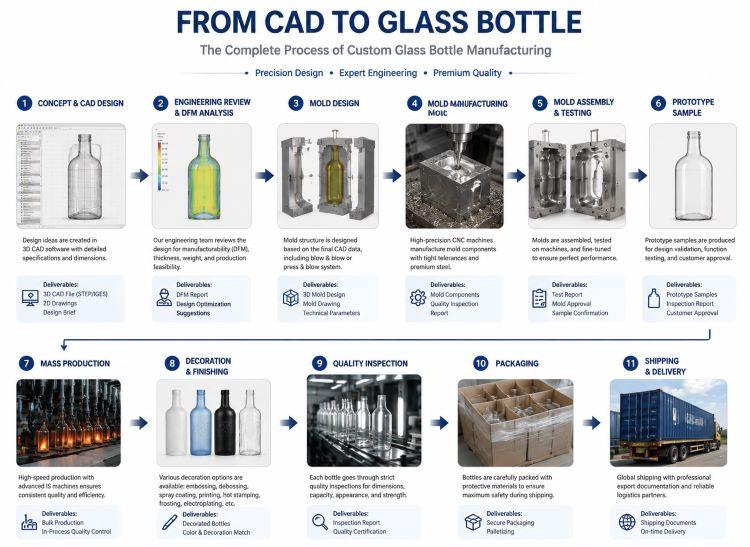
A typical development workflow looks like this:
Bottle Concept
CAD Design
Engineering Review
Design Optimization
Mold Design
Prototype
Sample Testing
Decoration Development
Mass Production
Quality Inspection
Global Shipping
Each stage builds upon the accuracy of the original CAD model.
How BOLI GLASS Supports Designers
At BOLI GLASS, we work closely with:
Packaging design agencies
Industrial designers
Branding studios
Spirits brands
Beverage companies
Our engineering team reviews CAD files before mold production and provides recommendations to improve manufacturability while preserving the original design intent.
Our capabilities include:
Custom glass bottle development
Super Flint glass
Mold engineering
Prototype sampling
Decoration services
OEM & ODM manufacturing
Worldwide export
Frequently Asked Questions
What CAD format is best for glass bottle manufacturing?
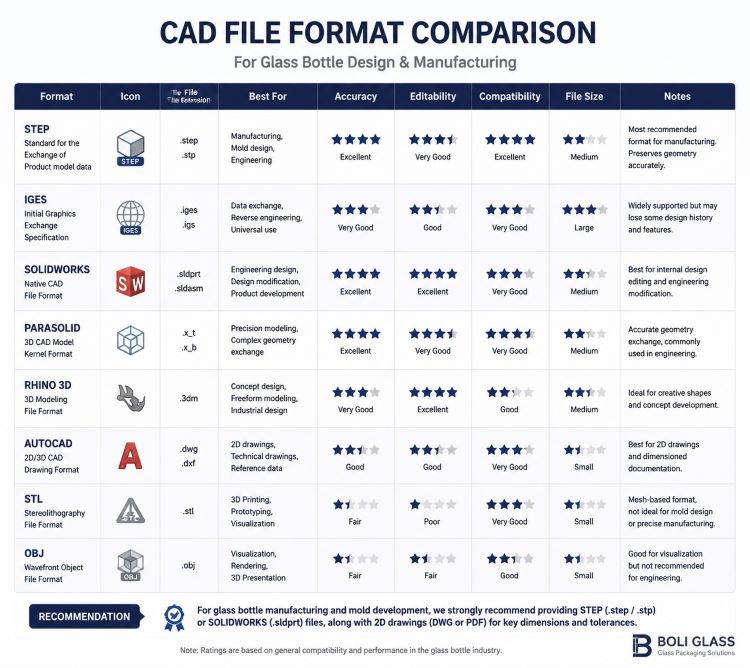
STEP (.stp) is the preferred format because it preserves precise engineering geometry.
Can manufacturers modify my CAD file?
Yes. Most manufacturers perform engineering optimization before tooling.
Can I submit a Rhino file?
Yes, but STEP or SolidWorks files are generally preferred.
Do I need technical drawings?
Yes. A 2D engineering drawing with critical dimensions helps reduce misunderstandings.
Can embossed logos be included?
Yes, provided the embossing depth follows manufacturing guidelines.
How long does CAD review take?
Most preliminary engineering reviews can be completed within a few business days.
What if my design cannot be manufactured?
An experienced manufacturer should suggest modifications that retain the design intent while improving production feasibility.