A Complete Guide to Designing Custom Spirits Bottles: From Branding to Manufacturing
Article release time:8 2026 Pageview:154
A Complete Guide to Designing Custom Spirits Bottles
Why Bottle Design Matters
In the competitive spirits market, the bottle is more than a container—it is your brand's primary offline marketing vehicle. With consumers making purchasing decisions in seconds, custom glass design directly drives brand equity and sales.
Shelf Impact: Unique silhouettes, distinctive heights, and light-refracting glass cuts capture consumer attention in crowded retail settings.
Premium Positioning: Bottle weight, base thickness, and tactile decorations signal craftsmanship, justifying higher price points and margin potential.
-
Consumer Perception: Structural design communicates brand story, origin, and flavor profile—from traditional heritage to clean, modern minimalism—before the bottle is ever opened.
Bottle Shape Trends
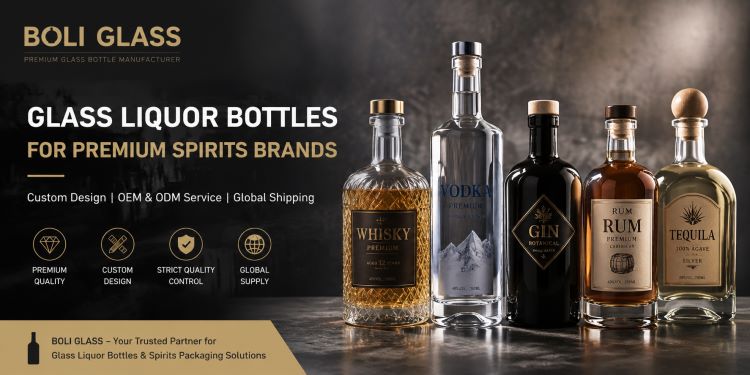
Modern spirits packaging relies on recognizable structural archetypes tailored to specific categories and brand personalities.
| Shape Style | Design Characteristics | Typical Categories |
| Nordic / Cylindrical | Straight walls, clean lines, modest shoulders, modern minimalism | Gin, Vodka, Modern Whiskies |
| Square & Geometric | Bold sharp angles, strong shelf presence, masculine profile | Bourbon, Tequila, Aged Spirits |
| Heavy Base (Punt / Solid Base) | Extra-thick bottom glass ($15\text{mm} - 30\text{mm}$), low center of gravity | Luxury Tequila, Ultra-Premium Rum |
| Vintage & Apothecary | Rounded shoulders, short neck, tactile embossing, rustic aesthetic | Small-Batch Craft Spirits, Bitters |
| Minimalist Luxury | Tall slender profiles, subtle curves, high clarity, restrained decoration | Single Malt Whisky, Premium Cognac |
| Eco / Lightweight | Reduced glass weight, optimized structural ribs, sleek contours | Sustainable Brands, High-Volume Spirits |
Decoration Options
Secondary finishing techniques transform standard or custom glass shapes into distinctive visual art.
Embossing & Debossing: Raised or recessed glass details created directly within the mold cavity during forming.
Acid Frosting: Chemical etching that creates a soft, tactile matte finish across full or selective bottle areas.
Spray Coating: Application of organic or inorganic coatings available in full matte, high-gloss, gradient, translucent, or solid opaque colors.
Electroplating & Metallization: Vacuum deposition creating reflective gold, silver, copper, or iridescent chrome finishes.
Screen Printing (ACL): High-precision ceramic or UV-cured inks applied directly to the glass surface.
Hot Stamping: Thermal transfer of metallic foils for high-shine accents, crests, and borders.
Ceramic Transfer Decals: Hand-applied high-detail artwork baked onto glass at high temperatures for extreme durability.
Bottle Engineering
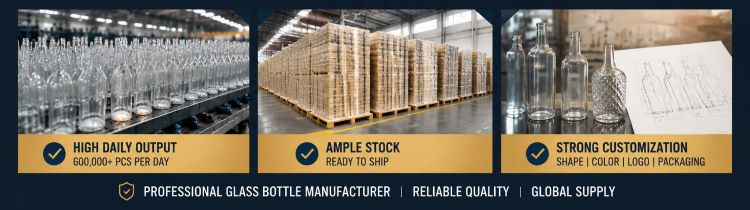
Successful glass packaging balances aesthetic form with high-speed manufacturing, filling line stability, and transit durability.
Glass Weight Distribution: Balancing glass gob distribution to maintain structural strength while achieving desired handfeel.
Wall Thickness Consistency: Ensuring uniform glass thickness to withstand internal thermal shock, carbonation pressure, and transit impacts.
Center of Gravity: Engineering the base width and height ratio to prevent tipping on automated high-speed washing, filling, and corking lines.
Top-Load Strength: Calculating vertical pressure resistance to prevent bottle crushing during automated cork insertion, capping, and pallet stacking.
Production Tolerances: Defining dimensional variances for fill lines, overflow capacity ($\pm \text{ml}$), neck inner diameter, and perpendicularity.
Mold Draft Angles: Incorporating a minimum $1.5^\circ - 2^\circ$ draft angle on vertical surfaces to allow clean glass release from mold cavities.
Working With a Glass Bottle Manufacturer
Developing a custom bottle requires a disciplined sequence from initial concept to global delivery:
    RFQ
     ↓
 3D Design
     ↓
Engineering (DFM)
     ↓
 Prototype
     ↓
 Glass Sampling
     ↓
 Mass Production
     ↓
  Inspection
     ↓
  Shipping
Frequently Asked Questions
How much does custom bottle development cost?
Costs vary based on complexity and size. Sample molds typically range from $1,500 to $3,500, while full production molds range from $6,000 to $15,000+.
How long does custom bottle development take?
The full process generally takes 8 to 12 weeks: 1–2 weeks for 3D design/engineering, 3–4 weeks for sample molds and physical glass samples, and 4–6 weeks for mass production mold fabrication and manufacturing.
Can I customize the glass color for low-volume runs?
While custom glass batch formulations require very high volumes, smaller runs can achieve custom colors using spray coatings, tinting glazes, or electroplating finishes.
What is the minimum order quantity (MOQ) for custom bottles?
Standard MOQs for custom Super Flint glass bottles typically range between 3,000 and 6,000 units per production run.
Can I submit my own CAD designs?
Yes. You can provide standard 3D file formats such as .STEP or .IGS. Factory engineers will perform a Design for Manufacturability (DFM) check before mold cutting.
What file formats are best for custom bottle development?
3D CAD files in .STEP (.STP) or .IGS formats are preferred. Artwork for embossing, screen printing, and foil stamping should be provided in vector format (.AI or .PDF).
What is the average lifespan of a production mold?
High-quality cast iron or alloy glass molds typically produce 500,000 to 1,000,000+ bottles before requiring maintenance or replacement.
Can custom bottle weight be reduced without sacrificing strength?
Yes. Computer-aided engineering (CAE) allows for optimized glass distribution, maintaining structural top-load strength while reducing overall weight for eco-friendly lines.
Are custom decorated glass bottles recyclable?
Yes. Uncoated and standard decorated glass (such as ceramic ink printing) remains 100% recyclable. Specialized organic coatings or heavy metallization may require specific recycling handling depending on regional facilities.
How do I choose the correct neck finish and closure?
Select the closure based on target market expectations, sealing performance, and spirit chemistry. Ensure your manufacturer provides official neck finish technical drawings (e.g., GPI or standard cork finish specs) before finalizing closure tooling.